Troubleshooting Common Defects: Delamination, Warping, Support Failures
@/tmp/l1_en-defect-troubleshooting.html
Read More →Post-Processing Guide: Wash, Cure, Remove Supports & Finish
@/tmp/l1_en-post-processing-guide.html
Read More →The Complete SLA Print Workflow: 7 Steps from STL to Finished Part
@/tmp/l1_en-sla-print-workflow.html
Read More →Why Supports Are Non-Negotiable: A Complete SLA/FDM Guide
@/tmp/l1_en-support-structures-guide.html
Read More →Slicing Software 101: Turning a 3D Model into Printer Instructions
@/tmp/l1_en-slicing-software-101.html
Read More →STL / OBJ / 3MF: How to Hand a Model to the Printer
What Each Format Does STL: describes surfaces with triangle meshes, accepted by nearly all slicers. Downside: geometry only, no color/material/unit, and chord-height settings can lose precision. OBJ: supports vertex color, material groups and multiple objects, good for colored or assembled models. 3MF: modern open format based on XML, carrying units, materials, metadata and even slice […]
Read More →Reading 3D Printing Specs: Accuracy, Layer, Spot, Roughness
Reading the Four Numbers on a Spec Sheet Accuracy (tolerance): the stable dimensional deviation, usually XY better than Z. A stated ±0.1mm does not guarantee every feature, as geometry and supports matter. Layer height: single-layer thickness, typically 0.05–0.2mm. Smaller is finer with fewer stair steps, but print time multiplies. Spot / nozzle diameter: sets the […]
Read More →What Can 3D Printing Do? 10 Real Industrial Use Cases
3D Printing in Industry, Not a Toy The 10 scenarios below are already at scale, not concepts. Aerospace: topology-optimized lightweight brackets and fuel nozzles cut significant weight. Medical implants: titanium bone plates and acetabular cups customized from patient CT. Dental: aligners, temporary crowns, surgical guides — DLP/SLA produce millions daily. Automotive: prototypes, assembly jigs, low-volume […]
Read More →SLA or FDM for Your First Industrial Printer?
The Short Answer Pick SLA when you need “refined looks, small size, smooth surface”; pick FDM when you need “strong, cheap, large, load-bearing functional parts”. They are complementary, not competitors. Six Dimensions Compared Accuracy & surface: SLA reaches 0.05mm layers with low Ra and sharp edges; FDM shows layer lines limited by nozzle diameter. Material […]
Read More →What Is 3D Printing? The 7 Main Technologies in Plain Words
What Is Additive Manufacturing 3D printing is formally called Additive Manufacturing (AM): unlike machining that removes material, it builds parts layer by layer. The workflow is just three steps — model, slice, print. Here is the 7 mainstream industrial technologies in one line each. The 7 Main Technologies FDM (Fused Deposition Modeling): a heated nozzle […]
Read More →7 Industries Transformed by Industrial SLA 3D Printing in 2026
From dental labs to aerospace tooling, discover seven industries where industrial SLA resin printing is replacing traditional manufacturing.
Read More → SLA Technology
Understanding SLA 3D Printing Resolution: XY vs Z Axis Explained
A practical breakdown of how laser spot size and layer thickness define SLA print resolution — and what it means for your parts.
Read More →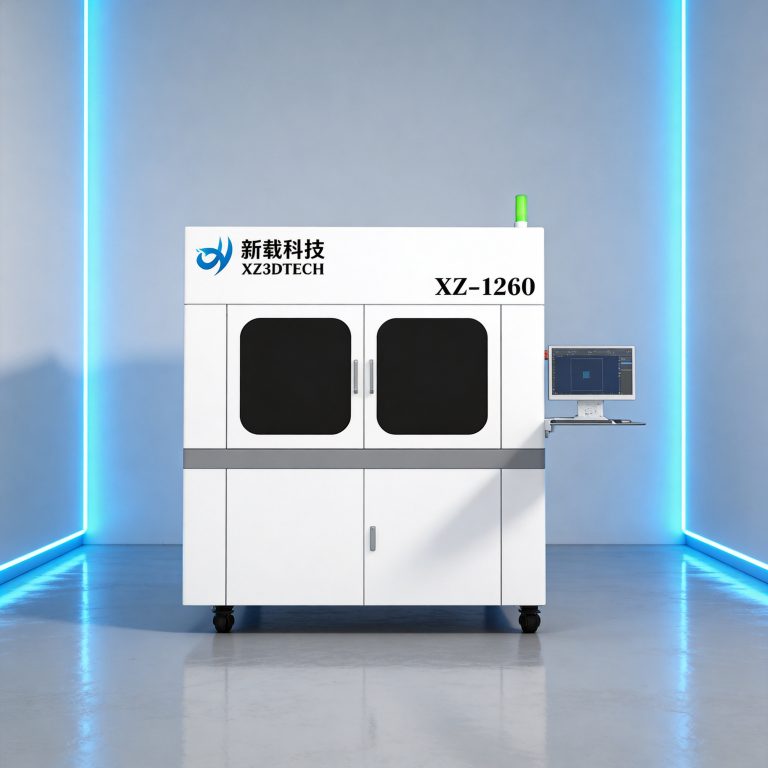 SLA Technology
SLA vs FDM 3D Printing for Industrial Manufacturing: Which Is Right for You?
When investing in industrial 3D printing equipment, one of the first and most important decisions you will face is choosing between SLA (Stereolithography) and FDM (Fused Deposition Modeling). Both technologies have matured significantly, but they serve fundamentally different purposes in a manufacturing environment. Making the wrong choice can mean wasted capital, missed production deadlines, and […]
Read More → SLA Technology
How to Choose an Industrial SLA 3D Printer: A Complete Buyer’s Guide (2026)
Choosing the right industrial SLA 3D printer is one of the most important decisions for any manufacturing operation. With dozens of models on the market — ranging from $2,000 desktop units to $200,000 industrial systems — the selection process can feel overwhelming. This guide breaks down the eight critical factors you need to evaluate before […]
Read More →